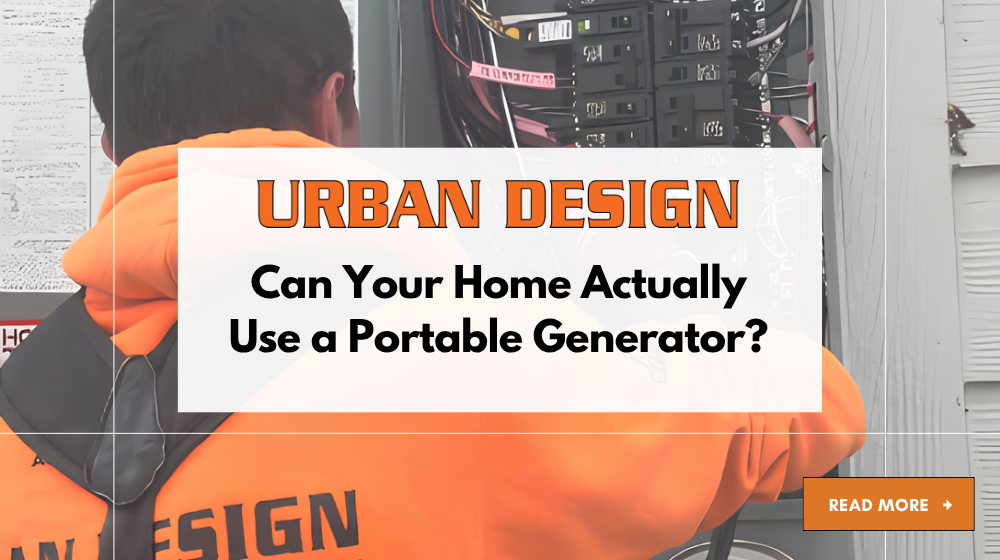
Most people buy a portable generator right after an outage. The power goes out for three days, the food in the fridge goes bad, and the next week there’s a generator in the garage. Then the following winter, the power goes out again and they’re running extension cords through a window to keep one space heater and a lamp alive.
That was roughly the situation at Michael’s house. He had the generator. What he didn’t have was a way to get that power into his home’s electrical system.
The problem: two power sources, one panel
You can’t just wire a generator into a main service panel and call it done. The panel is already fed by utility power. If the generator feeds the same bus bars at the same time, you’ve created a backfeed condition, which puts voltage on the utility lines outside the house. That’s dangerous for anyone working on those lines and hard on the generator.
So the electrical system needs a hard rule: utility power or generator power, never both.
There are a couple of ways to enforce that rule. A full automatic transfer switch is one. A mechanical interlock kit is the other, and it’s the more economical route when the homeowner already owns the generator and is willing to flip a few breakers by hand.
Michael had already purchased an interlock kit. He wanted Urban Design to install it correctly.
What an interlock actually is
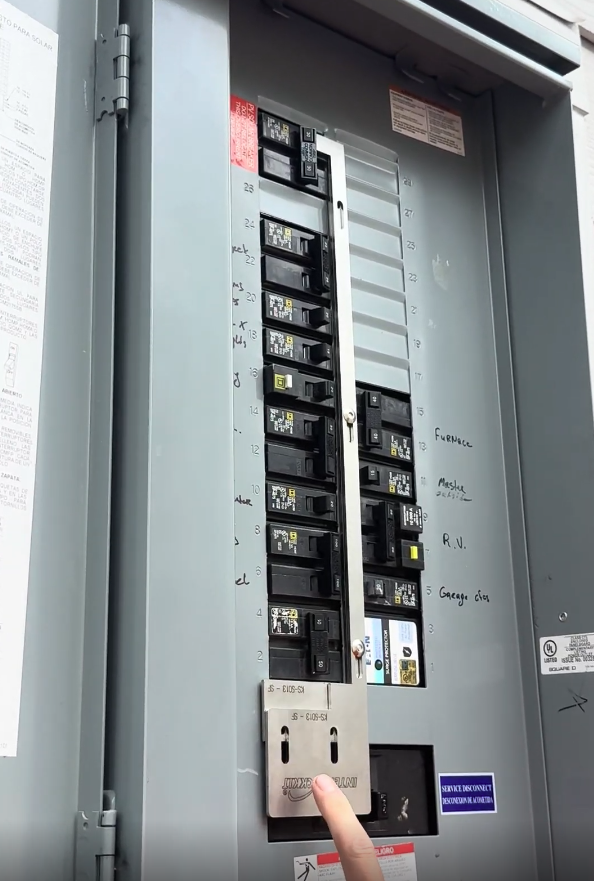
If you look at the photo of the panel, there’s a sliding metal plate in the middle of the breaker column. That’s it. That’s the interlock.
It isn’t electronic. It’s a piece of steel that physically blocks one breaker from being switched on while the other one is on. Slide the plate one direction and you can energize the main. Slide it the other direction and you can energize the generator breaker. There is no position where both are on.
In plain terms:
Utility power → home
or
Generator power → home
Never both at once. The panel enforces it mechanically, so it doesn’t depend on somebody remembering the correct sequence at 11 p.m. in the rain.
The work Trent performed
This panel had some history. Handwritten circuit labels, an existing solar placard on the door, and limited real estate in the enclosure. Fitting a generator breaker and interlock into a panel that’s already been worked on is where the job goes from “install a kit” to “make this work in the space that actually exists.”
Trent’s scope:
- Installed the customer-supplied interlock kit
- Installed a 50-amp generator breaker
- Installed the generator inlet and connection point
- Replaced roughly two feet of conductor between the main service panel and the generator plug
- Verified the installation, connections, and interlock operation before closing the panel
The wiring replacement is worth pointing out. The existing run between the panel and the plug location wasn’t going to be part of a finished installation, so it got replaced rather than reused. It’s two feet of wire. It’s also the two feet that carries the entire generator load.
What changed for the homeowner
Before: a generator sitting in the garage and a drawer full of extension cords.
After: a labeled inlet on the outside of the house, a dedicated 50-amp breaker in the panel, and an interlock plate that makes the switchover a deliberate, repeatable process. When the power goes out, Michael shuts off the main, slides the interlock, starts the generator, plugs in, and energizes the circuits he needs.
Owning a generator and being able to use a generator are two different things. This job closed the gap between them.
Common questions
Do I need a transfer switch or an interlock?
Both solve the same problem. An interlock kit is typically less expensive and is operated manually. An automatic transfer switch costs more and handles the switchover for you, which matters more with a standby generator than a portable one.
Will an interlock work on any panel?
No. Interlock kits are panel-specific and have to match the make and model of your load center. That’s one of the first things we check.
Can I install one myself?
This is work inside an energized service panel, and it’s permitted electrical work in most jurisdictions. It should be done by a licensed electrician.
Which circuits can I run?
That depends on the output of your generator. Part of doing this properly is identifying which circuits are worth powering during an outage, which usually means the furnace, refrigerator, well pump, and a few lighting and receptacle circuits.
Thinking about backup power before the next outage?
Urban Design handles generator integration, panel work, and backup power planning throughout Butte County and the surrounding areas. If you already own a portable generator, we can tell you what it will take to connect it safely to your home. If you don’t own one yet, we can help you figure out what size you actually need before you buy.