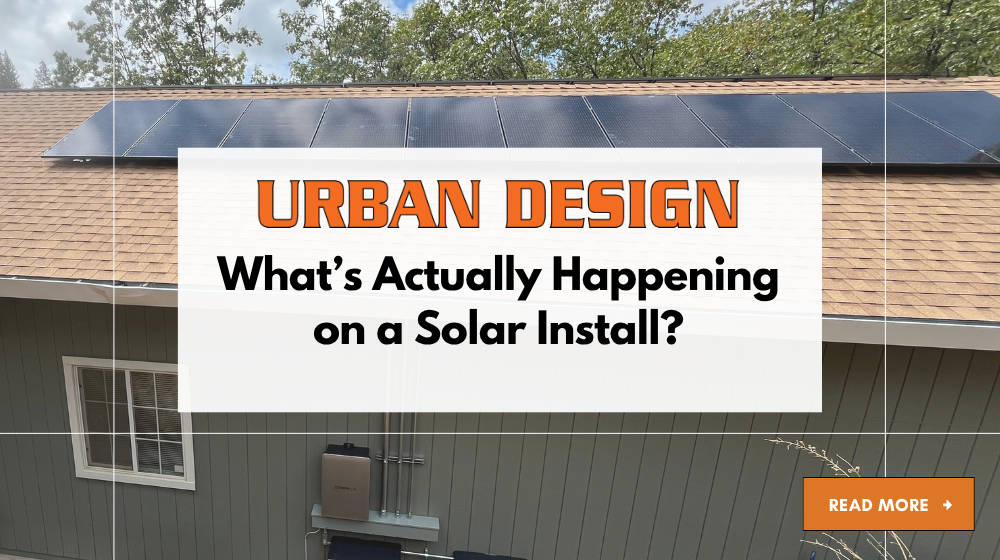
If you drive past a solar job at the end of the day, you see panels on a roof. That’s about ten percent of the work.
The other ninety percent is the stuff nobody photographs — sealing the roof, mounting the rails, running the pipe, wiring it all together, and hanging the batteries. That’s where the job is either done right or done fast.
Darla and Terry are getting a 15.58 kW system with battery storage. Here’s what our crew is actually doing out there, in the order it happens.
What’s going in
- 38 Qcells solar panels, 410 watts each
- Enphase IQ8 microinverters (small boxes that convert the panels’ power into the kind your house uses)
- 2 Enphase IQ Battery 10C batteries
- An Enphase IQ Combiner 6C (the hub where all the wiring from the roof comes together)
- Roof mount, with flashing, racking, conduit, and wiring
Thirty-eight panels is a big residential system. Adding two batteries tells you the goal isn’t just a smaller power bill — it’s using more of their own electricity and keeping the lights on when the grid goes down.
First: we put holes in your roof, then we make them disappear
Before a single panel goes up, the crew finds the rafters (the wood beams under your roofing) and installs flashing (metal plates that seal around each bolt so water can’t get in) at every single mounting point.
This is the part of a solar install that decides whether you have a problem in five years.
Every attachment is a hole in your roof. Flashing is what turns that hole into a non-issue — it tucks under the shingles so water runs right over it, the same way it always did. Done right, you’ll never think about it again. Done wrong, you find out during the first real storm.
We take our time here because it’s the one part of the job that’s genuinely expensive to fix later.
Next: the rails
The racking (the aluminum rails the panels bolt onto) does two jobs. It holds the panels, and it spreads their weight — plus wind and earthquake forces — into the actual structure of the house.
Layout matters more than you’d think. The rails have to line up with the panel size, the mounting points have to land on real structure, and the whole array has to fit the roof while leaving the clear space that fire code requires around the edges. On a 38-panel system, being an inch off at the start becomes a real headache three rows later.
Then: the microinverters
Every panel on this system gets its own little converter box mounted on the rail underneath it.
Here’s why that’s worth caring about. Solar panels make DC power (the kind batteries use). Your house runs on AC power (the kind that comes out of your outlets). Something has to translate between them.
Older systems used one big central box to do all that translating for the whole array. Which meant if one panel got shaded or underperformed, it dragged everything down with it — and if that one box failed, your entire system was dead.
With microinverters, the translating happens at each panel, so every one works on its own. Afternoon shade on one corner of the roof doesn’t cost you the rest of the system. And you get panel-by-panel monitoring, so if something goes sideways later, we know exactly which panel to look at instead of guessing.
These particular ones (the IQ8s) can also create their own mini power grid inside your home, which is the piece that makes the batteries useful during an outage.
Then: the pipe and the hub
This is the point where a solar job becomes an electrical job.
All 38 microinverters get wired into circuits, those circuits run down the side of the house inside conduit (the metal or plastic pipe that protects the wiring), and everything ends up at the combiner — the hub where the roof wiring comes together, gets its safety protection, and connects to the monitoring that shows you how much power you’re making.
Conduit runs get planned before anybody picks up a pipe bender. Where it goes, how it’s supported, how the bends look, how much wire fits inside. A messy conduit run is the number one sign of a rushed solar job, and it’s on the side of your house forever.
Finally: the batteries
Both Enphase IQ Battery 10C units went in the same day.
A battery changes what solar even is. Without one, solar is a daytime thing — you make power when the sun’s up, whatever you don’t use goes out to the utility, and after dark you’re buying it all back. With a battery, that extra production goes into storage instead, and your house pulls from it at night.
In California right now, that difference is a big deal. The credit you get for sending power out to the grid isn’t what it used to be under the old rules, so keeping your own electricity and using it during the expensive evening hours is generally worth more than exporting it.
The other benefit is the one you feel during a storm. Regular grid-tied solar (solar without a battery) actually shuts itself off during a power outage. That’s required — it keeps your system from pushing electricity onto lines that utility crews are out there working on. A battery plus the right equipment gives your home a way to keep running anyway.
Where things stand
The crew has the flashing, racking, microinverters, conduit, combiner, and both batteries installed. That’s the backbone of the system done.
Still ahead: setting the panels, final electrical connections, commissioning (testing and turning the system on), inspection, and then permission to operate (the utility’s official sign-off before you can flip the switch).
That last one is worth knowing about ahead of time. Even after the work is finished, the system has to pass inspection and get cleared by the utility before it can run. Nobody on the crew controls that timeline — it’s just part of every solar project, everywhere.
Questions we get a lot
Does solar work during a power outage?
Not on its own — it shuts down to protect the utility crews working on the lines. Adding a battery with the right equipment is what lets your house keep going.
How many batteries do I need?
Depends what you want running and for how long. Keeping the fridge, lights, and internet on overnight is a very different ask than running central air for three days. We size it off your real usage, not a guess.
Won’t drilling into my roof cause leaks?
Not when it’s flashed properly. Every attachment point on a roof-mounted system we install gets sealed.
Microinverters or one big inverter — does it matter?
Microinverters cost a bit more but handle shade better, keep one bad panel from affecting the rest, and let us see each panel individually. One central inverter is cheaper, but everything shares the same fate.
How long does an install take?
The hands-on work on a system this size usually runs a few days. Inspection and utility sign-off add time after that.
Thinking about solar with a battery?
We design and install solar and battery systems all over Butte County and the surrounding areas. Before we recommend a size, we look at your actual power usage, your roof, and your rate plan — including whether a battery makes sense for you at all.